Receive the stock. Store it securely. Pick the order. Pack it. Ship it.
That model still has its place, but technology businesses are asking for something more.
That changes what businesses should expect from a logistics partner.
What is a technology 3PL?
It combines specialist logistics with services designed around technology products and the operational requirements that come with them.
For businesses using technology, this can include:
- Secure storage and technology fulfilment
- Device preparation and configuration
- Technical kitting
- Accessory attachment
- Customer-specific fulfilment requirements
- Returns and reverse logistics
- Device grading and lifecycle services
Why technology needs a different approach to logistics
Technology products are not always straightforward items to pick and ship.
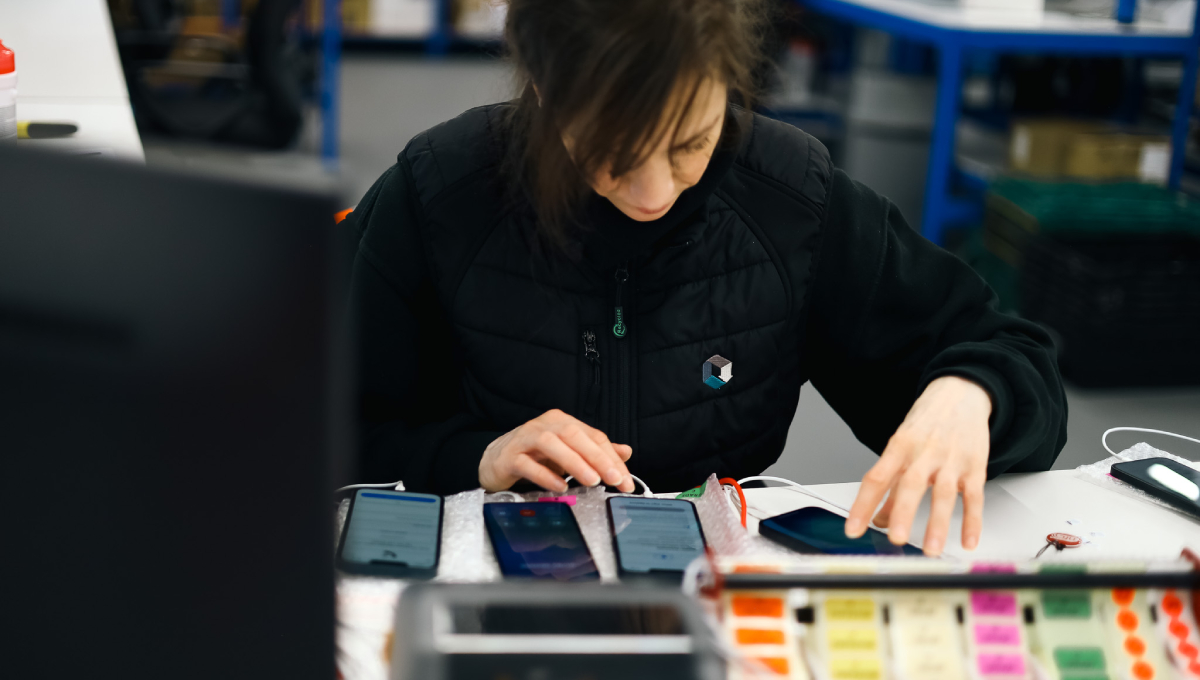
A warehouse may hold hundreds or thousands of smartphones, tablets, laptops or connected devices that look almost identical but have different requirements depending on the customer, deployment or order.
A device might need additional preparation before it can be fulfilled.
Accessories may need to be included with the correct device.
A customer may have specific requirements that need to be followed consistently across every order.
This creates complexity that a conventional pick-and-pack operation may not be designed to manage.
For technology businesses, the question is therefore becoming less about how quickly a product can be shipped and more about how much of the work surrounding that product can be handled within the fulfilment operation.
Technical services are becoming part of fulfilment
This is one of the biggest changes in technology logistics.
The distinction between logistics and technical services is becoming less defined.
Previously, a business might have used one provider to store and ship products, while internal teams or another supplier handled technical preparation.
A technology-focused 3PL can bring more of these activities together.
The result is a fulfilment process that can support the product beyond simply moving it from a warehouse shelf to a delivery vehicle.
For businesses handling technology at scale, that can mean less internal processes and a more consistent route from receipt to delivery.
The commercial value of a more capable 3PL
Technical capability is not simply about adding more services.
It is about solving pre-existing operational problems.
If internal teams are spending time preparing devices, managing accessories, coordinating fulfilment requirements or dealing with additional stages before an order can leave the warehouse, there is a cost to that work.
As volumes grow, those processes can become increasingly difficult to manage.
A specialist technology 3PL can take responsibility for more of those operational requirements, allowing businesses to focus its internal resources elsewhere.
This is where specialist technology fulfilment can create value.
The goal isn’t to make logistics more complicated.
It is to remove complexity from the technology business.
What should a technology business look for in a 3PL?
“Can you store and ship our products?”
For technology businesses, a better question may now be:
- What can you do before the product leaves your facility?
- Can the logistics provider handle the technical requirements around the product?
- Can it manage customer-specific fulfilment requirements?
- Can it support different product types and deployment models?
- Can it combine technology logistics with technical services?
- And can it maintain those processes as volumes increase?
High-value, serialised and data-bearing devices bring their own operational requirements. The logistics partner needs to understand the product, not simply the pallet.
The future of technology logistics
For technology businesses, the modern 3PL is increasingly becoming an extension of the wider operation rather than simply a location where products are stored.
The future of technology logistics and technology fulfilment is not just about moving products efficiently.
It is about combining logistics with the technical capabilities needed to prepare, fulfil and manage those products effectively.
That means the value of a technology 3PL isn’t only measured by how many boxes it can move.
It is also measured by how much operational complexity it can take away.
At Tech3PL, we believe technology needs a different kind of logistics partner.
Data-bearing devices change the risk profile
One of the biggest differences between technology and ordinary stock is that technology can hold data.
A phone, tablet or laptop isn’t simply an item with a product code.
It can contain business information, user credentials, customer data, applications and access to wider systems.
That means the device lifecycle doesn’t necessarily end when the product is returned to the warehouse.
Returns need to be controlled. Devices may need assessment, grading, rework or secure data erasure before they can be reused, resold or redeployed.
This is where technology logistics becomes closely connected to device lifecycle management.
The warehouse is no longer just a place where products are stored.
It becomes part of the wider control environment around those devices.
Visibility is more than knowing what’s in stock
For technology businesses, inventory visibility should answer more than one question.
It’s not just:
- How many do we have?
- It should also be:
- Which devices do we have?
- Where are they?
- What stage are they at?
- Where are they going?
- What has happened to them previously?
That is the value of individual-device tracking.
Serial and EAN information can help create a traceable record as technology moves through receiving, storage, fulfilment, dispatch and returns.
Instead of managing a batch of devices as one indistinguishable quantity, businesses can have a much clearer view of individual units.
For high-volume technology operations, that visibility can make a significant difference to inventory accuracy, operational control and accountability.
The technology supply chain doesn’t end at delivery
A common mistake is to think about logistics as ending when a device leaves the warehouse.
Technology doesn’t necessarily work that way.
Devices can be returned because they are faulty, replaced, upgraded, no longer required or reaching the end of their useful life.
That means reverse logistics is an important part of technology lifecycle management.
A returned device may need to be inspected, graded, repaired or securely wiped before its next destination is decided.
Some devices may have further commercial value. Others may need to be recycled or disposed of responsibly.
Without the right processes, every return can become another opportunity for cost, delay or risk to enter the supply chain.
With the right processes, returns become a controlled part of the device lifecycle.
Specialist technology logistics is about control
The value of a specialist technology 3PL isn’t simply having somewhere to store devices.
It is having the processes, systems and expertise to understand what makes those devices different.
Technology logistics needs to account for:
- Individual-device identification and tracking
- High-value inventory
- Data-bearing equipment
- Configuration and technical preparation
- Secure fulfilment
- Returns and reverse logistics
- Data erasure and lifecycle management
- Traceability and accountability
These requirements are difficult to manage effectively when technology is treated as just another category of warehouse stock.
The more complex the device lifecycle becomes, the more important specialist handling becomes.
Technology is different. Your logistics should be too.
Technology has changed the way businesses operate, but the logistics supporting it cannot always be managed using traditional stock processes.
A smartphone isn’t just a box on a shelf.
A laptop isn’t just a SKU.
A tablet isn’t simply another unit in inventory.
Each device can have a unique identity, a destination, a user, a history and, potentially, data attached to it.
That is why high-value, serialised, data-bearing technology requires a different approach.
The question isn’t whether technology can be managed like ordinary stock. It can.
The question is whether it should be.
When the cost of losing visibility, control or accountability is high, specialist technology logistics becomes less of a nice-to-have and more of a fundamental part of managing the technology lifecycle properly.
Technology is different. Your logistics should be too.